
Aluminum-Ion “Super Batteries” Are Back in the Spotlight
Could aluminum-ion batteries become the next big thing after lithium-ion?
1/7/20263 min read
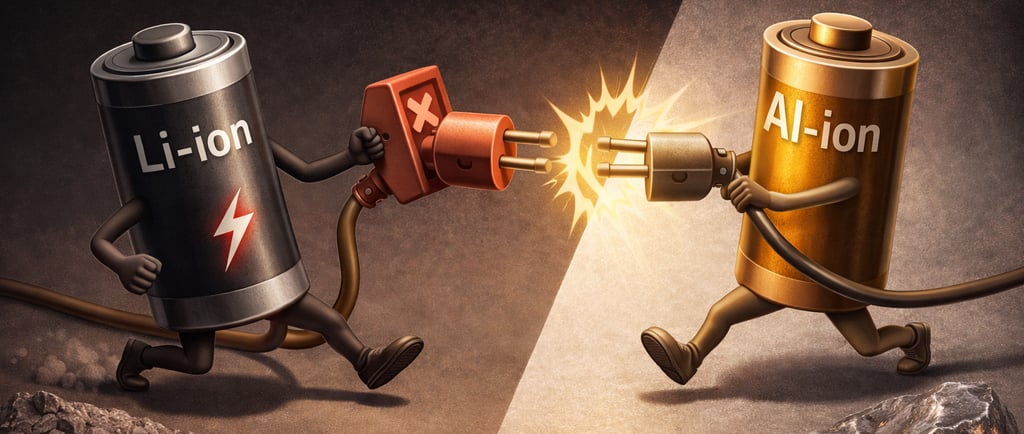
Battery technology is moving fast, and a new wave of interest is building around something that sounds almost too good to be true: the aluminum-ion battery — sometimes described online as a “super battery.”
Unlike today’s lithium-ion batteries, which power most electric cars and home storage systems, aluminum-ion batteries use aluminum as a key material in the chemistry. And that matters because aluminum is cheap, widely available, and already produced at massive scale worldwide.
So what’s the big news? Researchers and battery developers have been reporting improvements in performance and stability, fueling fresh optimism that aluminum-ion batteries could become a serious option for the future of energy storage — especially for the electric grid.
What exactly is an aluminum-ion battery?
Think of a battery like a system that moves charged particles back and forth while you charge and use it. In lithium-ion batteries, those particles are lithium ions. In aluminum-ion batteries, the key charge carrier involves aluminum ions.
The appeal is simple: aluminum is one of the most common metals on Earth. If aluminum-ion batteries can be manufactured reliably, they could reduce dependence on materials that are harder to source and more expensive — such as lithium, cobalt, or nickel.
Why the technology is getting attention again
Aluminum-ion batteries have been researched for years, but the biggest challenge has been turning a promising lab idea into something that performs well in the real world.
What’s changed is that newer designs and materials are improving several key areas:
Cycle life (how many times the battery can charge and discharge)
Charging speed (some prototypes show fast-charging potential)
Stability (reducing degradation and improving consistency)
Safety (some chemistries may be less prone to overheating)
While it’s too early to say aluminum-ion batteries are ready to replace lithium-ion in electric vehicles, progress is strong enough that the industry is paying attention again.
The big advantage: cost and supply
One of the biggest stories in batteries isn’t just performance — it’s supply chains.
Lithium demand is rising rapidly. At the same time, many battery materials come with complicated mining, refining, and geopolitical pressures. Aluminum, on the other hand, is already integrated into global manufacturing and recycling systems.
That’s why aluminum-ion batteries are often discussed as a possible “next-generation” solution for large-scale storage, where cost and durability matter more than squeezing the most energy into a small space.
Where aluminum-ion batteries could shine first
Even if aluminum-ion batteries don’t immediately power long-range electric cars, they could still play a major role in energy storage.
Experts see strong potential in:
1) Grid storage
Electric grids need batteries that can store energy for peak demand, renewable backup, and stability. These systems don’t require ultra-high energy density — they need long life, safety, and low cost.
2) Home and commercial storage
As solar grows, demand for battery systems at homes and buildings continues to expand. Again, affordability and lifespan are huge factors.
3) Short-range mobility
Scooters, e-bikes, small vehicles, and industrial machines could benefit if aluminum-ion batteries deliver good charging speed and reliable performance.
What still needs to be solved
The biggest barrier is energy density: lithium-ion still dominates for applications like long-range EVs, where every kilogram matters.
Aluminum-ion batteries also need more work on electrolytes, manufacturing methods, and scalability — the classic gap between an exciting prototype and mass production.
Why people connect this to Elon Musk and Tesla
Whenever battery breakthroughs appear, Tesla naturally enters the conversation. The company has pushed battery innovation hard and invests heavily in scaling energy storage. That doesn’t mean Tesla has officially launched an aluminum-ion battery — but it explains why the topic spreads quickly when it hits headlines.
Bottom line
Aluminum-ion batteries are not a guaranteed replacement for lithium-ion — at least not yet. But the latest improvements are real, and the push for cheaper, safer, and more sustainable energy storage is only getting stronger.
If aluminum-ion technology continues to advance, it could become one of the most important battery options for the clean-energy era — especially for the grid.


Our Office
Guangzhou, tianhe district, lin he xi lu 167 , office 1445 M870
Contacts


Moonday
Because every day is a Moonday